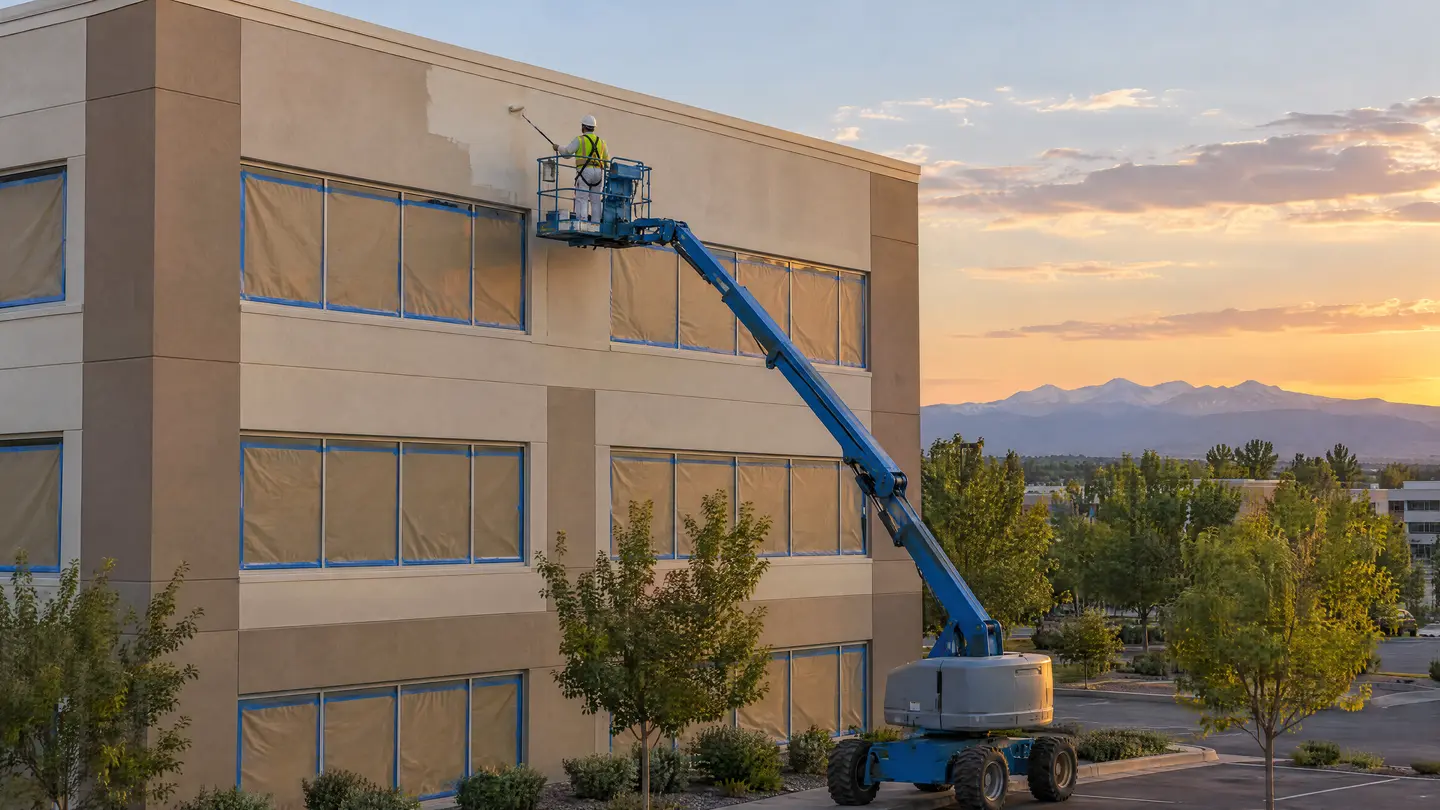
Once Front Range overnight lows start falling below freezing, usually some time in October, exterior painting can still go ahead, but each day's usable window gets shorter and the margin for error gets thinner. The real question becomes which hours, which walls, and which work should wait until spring.
Why the overnight low matters more than the daytime high
A clear 55-degree afternoon in Denver looks like good painting weather. The trouble is what happens after the crew leaves. A coating isn't finished when it looks dry to the touch; it keeps forming its film and curing for hours afterward, and it needs to stay within its temperature limits while that happens. Colorado's big day to night swings mean a wall that was comfortably warm at 2 p.m. can be near freezing by early evening.
Altitude adds a second complication. Intense sun heats south and west walls well above the air temperature, while north walls and shaded courtyards can stay cold all day. Low humidity helps coatings dry, but as the surface cools after sunset it can drop to the dew point, and moisture condenses right onto fresh paint. Latex coatings applied too cold, or wetted by dew before they've set, can crack, lose adhesion, or show sticky brownish streaks of surfactant leaching.
What sets the limits: the product data sheet
Every coating has its own application limits, and they're printed on the manufacturer's product data sheet. Typical data sheets list a minimum air temperature, a minimum surface temperature, and a requirement that the surface stay a few degrees above the dew point, often stated as 5°F. Some products are formulated for cooler application and some need more warmth, so there is no single cutoff that applies to every job. Many data sheets also say the temperature has to stay above the minimum for a stated period after application, so read that line as closely as the minimums.
Primers, sealants and patching compounds have their own limits too, and they aren't always the same as the finish coat's. A job can be legal for the topcoat and too cold for the sealant that has to go in first.
Spec Note
If your specification names a product, the data sheet for that exact product governs. A "low temperature" version of a coating is a different product with its own sheet, not a looser reading of the original one.
Go or no-go: a quick decision table
Use this as a daily check, filling in the actual numbers from the data sheet for the products on the job.
| Condition | Go | Hold or stop |
|---|---|---|
| Surface temperature | Measured on the wall itself at or above the data sheet minimum, and rising when work starts | Below the minimum, or air is warm but the wall is still in shade and cold |
| Overnight low | Forecast stays above the minimum for the full period the data sheet requires after application | A freeze is forecast before the coating has had its stated time above the minimum |
| Dew point | Surface stays above the dew point by at least the data sheet margin through application and into the evening | Surface temperature closing in on the dew point late in the day, or visible dew or frost on the wall |
| Wind | Light and steady, within the aerial lift manufacturer's wind limits | Gusty downslope winds blowing dust onto wet paint, carrying spray drift, or exceeding lift limits |
| Substrate moisture | Dry after rain or snow, with masonry and wood moisture within the range the data sheet allows | Snowmelt running down the wall, frost in joints, or damp stucco after a storm |
Wind deserves extra attention near the foothills. Chinook and other downslope winds can arrive warm and dry, but strong gusts make spraying impractical, push debris into wet film and can ground boom lifts for the day.
How the workday changes in late season
On a typical commercial exterior painting project in late fall, the schedule follows the sun rather than the clock. In practice that means:
- Starting later in the morning, once frost has burned off and the first walls have warmed past the minimum.
- Working east and south faces first, then following the sun around the building.
- Saving north walls for the warmest stretch of the day, or deferring them to spring if they never warm enough.
- Stopping application early enough that the last coat has time to set before the surface cools toward the dew point.
- Checking the forecast low for every night of the cure period, not just the next day's high.
- Keeping coatings and sealants stored warm, since cold material straight from a truck or trailer can be below its own application limit.
On Site
Take readings on the wall, not in the parking lot. A surface thermometer and a digital hygrometer give you surface temperature, air temperature, relative humidity and dew point in a few minutes. Record them with the time and the wall location. That log shows the coating went on within the manufacturer's limits. Keep it in the job file.
What to do with work that won't fit before spring
Some projects simply won't finish in a shortening window, and forcing them usually costs more than waiting. The better approach is to sort the remaining work by what happens if it sits through winter.
Protect anything that lets water in
Freeze-thaw cycles are hard on open surfaces. Water that gets into cracks, failed sealant joints or bare wood freezes, expands and widens the opening, and the damage grows with each cycle. Bare wood, exposed or rusting steel, open joints and cracked stucco should be dealt with before the cold sets in, even if the full repaint waits. That might mean spot-priming exposed areas or replacing failed sealant on a warm day, using products whose own limits fit the conditions. This is targeted surface preparation and specialty coatings work, not a full paint job.
Let cosmetic work wait
Faded color, chalking and minor wear on otherwise sound paint won't get meaningfully worse over one winter. Painting it in marginal conditions risks a finish that fails early, which defeats the purpose. Push it to spring and do it once.
Finish what you started, or stop at a clean break
If a project is partly done, stop at a corner, control joint or other natural break so the spring work doesn't leave a visible line mid-wall. Make sure every surface that has been prepped or primed is either finished or protected, because primer left exposed all winter may need to be redone.
Use the winter for planning
Winter is a good time to do the parts of a project that don't need warm weather: the site walk, the condition record, the written scope listing preparation, products and coats for each surface, and the phasing plan for an occupied building. If you manage several properties, it's also a good time to put them on a planned repainting cycle so next year's exterior work starts early in the season instead of running into October again.
If you have exterior work you're trying to place before or after winter, request an estimate and we'll start with a site walk.