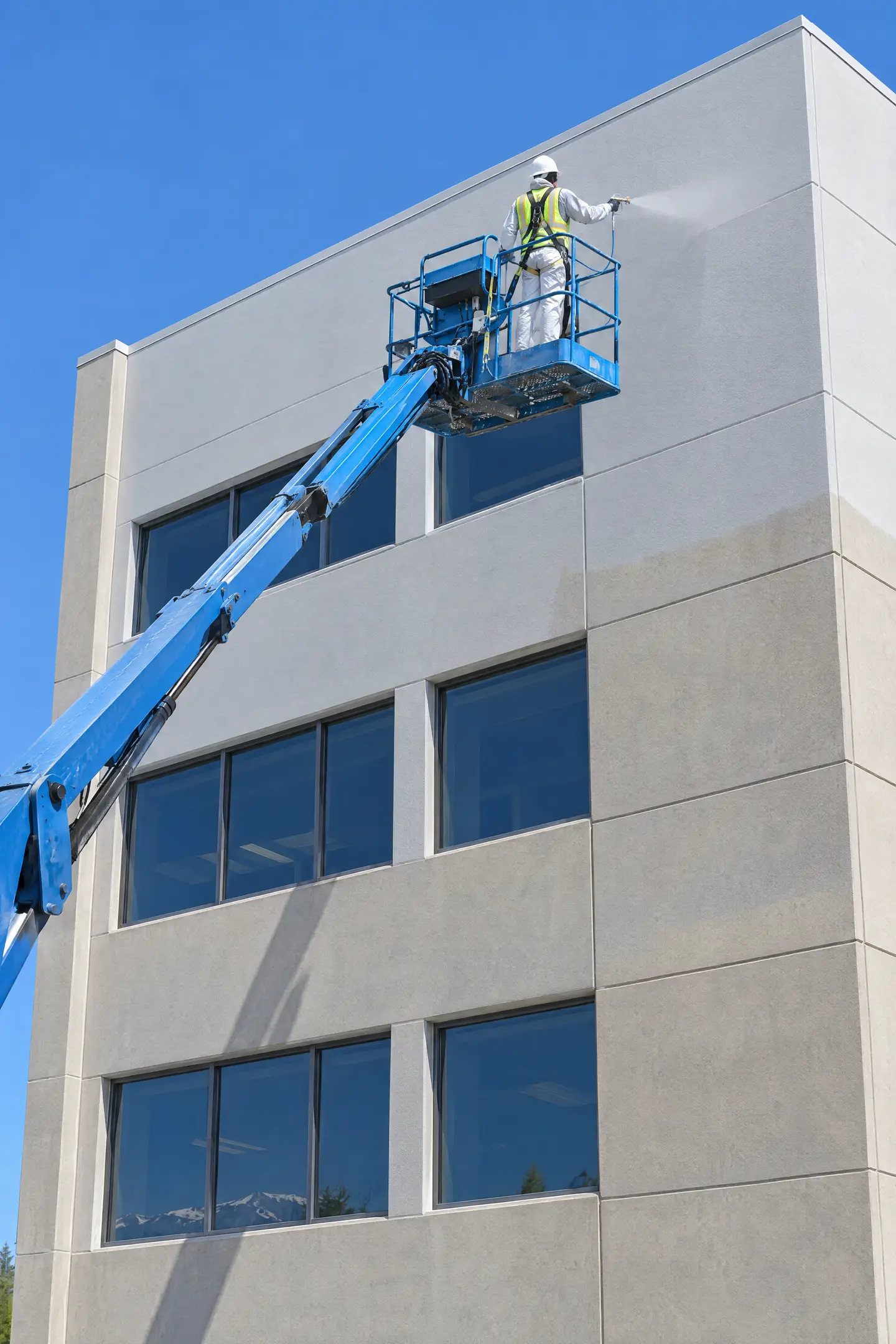
A low-temperature exterior coating lets you paint in colder weather, but only inside the limits printed on its product data sheet, and those limits cover far more than the air temperature. November on the Front Range gives you afternoons that can be workable, mornings that start with frost, and early sunsets that pull surface temperatures down fast. The data sheet tells you which part of that day actually qualifies. Read it before you schedule, not on the morning of the job.
Where the limits live on the data sheet
Most manufacturers put the numbers that matter in a block labeled something like Application Conditions, with drying and recoat times in a separate table and surface preparation in its own section. Don't confuse the product data sheet with the safety data sheet. The SDS covers hazards, handling and exposure. It won't tell you the minimum application temperature or the recoat window.
Minimum air and surface temperature
These are two separate readings, even when the data sheet lists a single number for both. Low-temperature acrylic products are often rated down to around 35°F, while many standard exterior products list 50°F, but check the exact product you're specifying. Formulas vary, and a manufacturer can rate the primer and finish in the same system differently.
Surface temperature is what the wet film actually experiences. Concrete, masonry and steel hold cold well after the air warms up, so a shaded north wall at 9 a.m. can sit well below the reading on the weather app. Measure the wall itself with a surface thermometer.
Look for one more line in this section: many data sheets say conditions must stay above the minimum for a stated number of hours after application. That requirement, more than the morning low, is usually what rules out a late afternoon start in November.
Dew point spread
The widely used rule, printed on many data sheets and taught through SSPC and AMPP, is that the surface must be at least 5°F above the dew point during application. Below that margin, moisture can condense on the substrate without being visible, and the coating goes down over a film of water.
On clear November evenings, surfaces radiate heat and can drop below the air temperature, while the dew point holds steady or climbs. Metal railings, doors, canopies and roof edges cool first. To check the spread, take air temperature and relative humidity with a sling psychrometer or a digital hygrometer, work out the dew point, and compare it with your surface reading at the wall being coated.
Relative humidity
Some data sheets also list a maximum relative humidity. Front Range air is usually dry during the day, but humidity rises toward evening and climbs quickly during upslope storms. If the product lists a cap, it applies through the drying period, not just at the moment the roller touches the wall.
Recoat and cure times
Dry times on a data sheet are normally stated at reference conditions, commonly 77°F and 50 percent relative humidity. Cold air stretches every one of them. Some low-temperature products publish a second set of times for cooler conditions. If yours doesn't, treat the reference figures as the shortest possible wait, not a schedule.
| Data sheet line | What it tells you | What changes in November |
|---|---|---|
| Dry to touch | When the surface stops being tacky | Takes longer, so dust and leaves stick to the film for longer |
| Recoat time | Minimum wait before the next coat | Often pushes the second coat to another day |
| Rain or moisture resistance | How long before the film can take water exposure | Evening dew can arrive before this window closes |
| Full cure | When the film reaches its intended hardness and resistance | Can run well past the job's completion date |
Why the label minimum is not a target
The minimum temperature is the lowest condition at which the manufacturer says the film will form properly, assuming everything else is right. It's a floor. Rolling a 35°F product at 36°F leaves no margin for thermometer error, a passing cloud, a breeze across the wall, or the shaded strip under a canopy.
Waterborne coatings form a film as water leaves and the binder particles fuse together. Cold slows that process, and a film that doesn't fuse properly can crack, chalk early or lose adhesion. A fresh latex film that catches dew can also show surfactant leaching, which appears as sticky tan, brown or whitish streaks. Some of these failures appear within days. Others take a season to show.
Our recommendation is simple: schedule application for conditions that sit comfortably above the minimum through the whole hold period, and treat the dew point spread as a hard stop rather than a guideline.
Common Mistake
Treating the forecast high as the application temperature. The high is reached briefly in mid afternoon. By the time a crew finishes cutting in and rolling an elevation, the surface is already cooling, and the hold period after application runs straight into the evening drop.
Building a November work window
A data sheet sets the limits. The building and the weather decide when you can stay inside them. A workable approach for late fall exterior work looks like this:
- Start only after frost and dew have burned off and a surface reading confirms the dew point spread, which often means late morning.
- Follow the sun around the building. East elevations warm first, south walls hold heat through midday, and west walls catch the afternoon.
- Expect north elevations to fail the readings on many November days, and plan to defer them to a warmer stretch or to spring.
- Stop applying early enough that the film gets its required hours above the minimum before the temperature drops at sunset.
- Size each day's work to the window, even if that means one coat on one elevation.
- Watch the forecast for upslope moisture and strong wind, both of which change surface conditions faster than the air temperature suggests.
On Site
Take readings at the wall being coated, not at the truck, and repeat them through the day. Log air temperature, surface temperature, relative humidity, dew point and the time. That record is what you point to if a coating problem is questioned later.
On our commercial exterior painting projects, coatings go on within the manufacturer's temperature and humidity limits, and in November that usually means shorter, planned windows rather than full days on the wall.
What owners and managers should ask for in the scope
A written scope should name the product and number of coats for each surface, and that product should be rated for the conditions you expect. If the job runs into late fall, ask how readings will be taken, when they'll be taken, and who decides that a day doesn't qualify.
Remember that the finish coat isn't the only product with limits. Primers, patching compounds, sealants and masonry fillers each have their own data sheets, and many dry more slowly than the paint. Preparation that hasn't cured can hold the whole job back, which is why surface preparation and specialty coatings deserve the same attention to temperature as the finish.
Finally, agree in advance on what happens if the weather closes in. Pausing an elevation partway and finishing it in spring is often the better result than pushing a coat onto a wall that's too cold.
If you have exterior work to fit in before winter or to line up for spring, you can request an estimate.